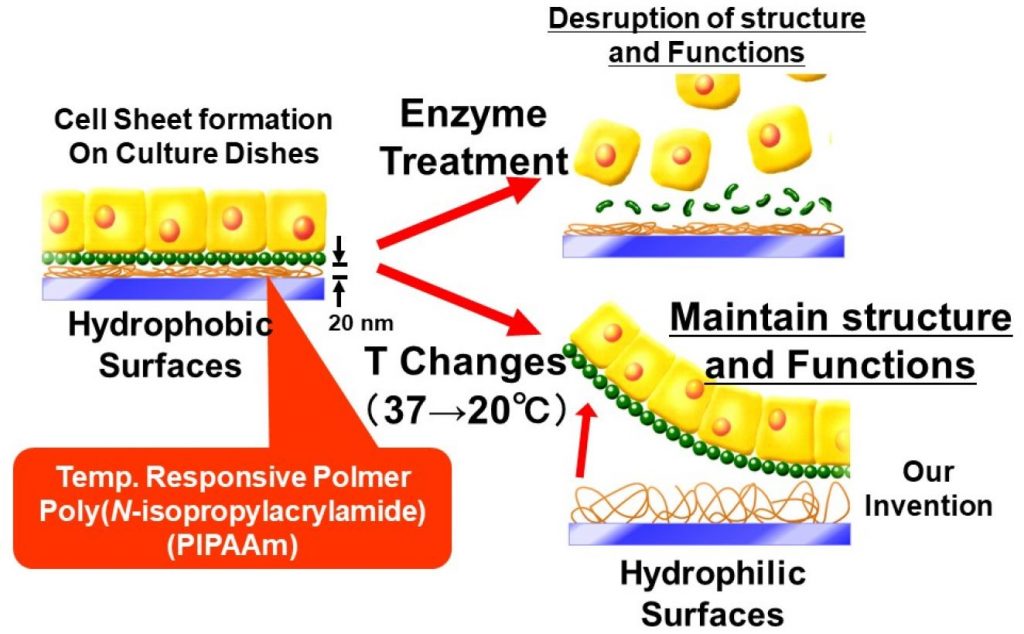
In 1989, Prof. Okano et al. have developed a temperature-responsive culture dish with a uniform 20-nm film of a temperature-responsive polymer, poly(N-isopropylacrylamide) (PIPAAm), by electron beam polymerization. A temperature-responsive culture dish UpCell® has been marketed globally. On this culture dish, cells are cultured at 37 °C and monolayered, and then cell sheet can be harvested with maintaining its biological structure and function by lowering to 20 °C. This invention allows cell sheet to be transplanted to living organs and/or constructed three-dimensional layered tissues.
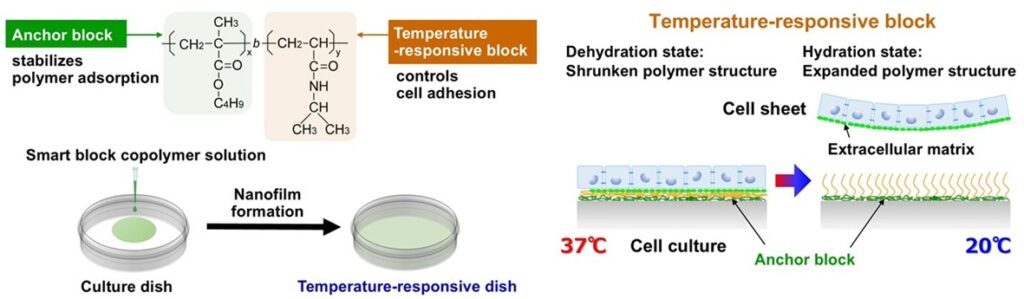
In recent decade, our group has proposed a novel fabrication method of temperature-responsive culture platforms via the physical nanocoating of smart block copolymers, called Smart Surface Cultureware (SSCW®) technology. Smart block copolymers contain hydrophobic blocks as polymer anchors which hydrophobically interact with cultureware surfaces. The SSCW shows a high water-stability even in cell culture environments with temperature changes. In addition, it is easy to control the film thickness on a nanometer scale by varying the polymer concentration in the coating solution, and thus the optimal smart surface can be customized for various cell types with different adhesive properties.
The Sustainable Development Goals (SDGs) have identified waste reduction and recycling/reuse of materials as important issues to reduce the environmental burden. We are developing a reusable temperature-responsive cell culture surface that combines the functions and features of both polymer and metal materials. Utilization of this reusable culture substrate will reduce the use of plastic products and contribute to the realization of cell sheet engineering that reduces environmental impact. This research is a collaboration between Keio University and the University of Tokyo.
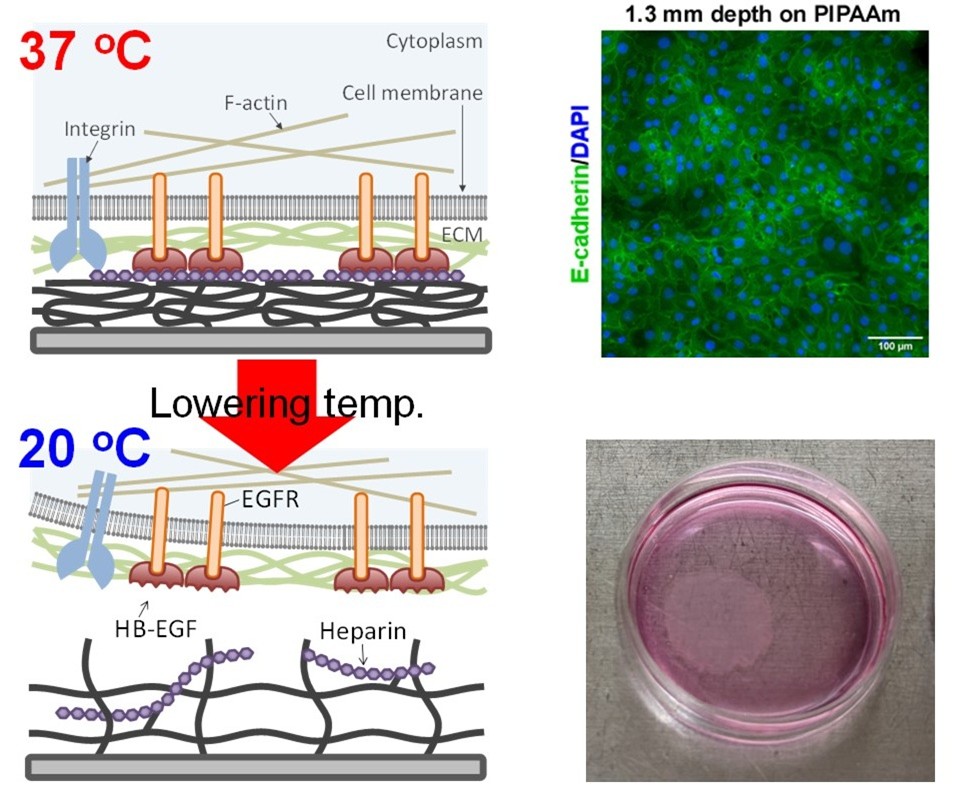
Cell sheet technology holds promise as an efficient means of transplanting hepatocytes for congenital metabolic liver diseases and acute liver failure. Heparin-immobilized thermoresponsive culture surfaces can bind heparin-binding EGF-like growth factor (HB-EGF) with enhanced stability and activity, resulting in the maintenance of cultured hepatocyte functions such as albumin secretion. At the same time, they allow the detachment as a sheet with lowering temperature due to decreased affinity interaction. Furthermore, subcutaneous transplantation of VEGF-secreting hepatocyte sheets by delivery of mRNA encoding vascular endothelial growth factor (VEGF) has improved the engraftment of transplanted sheets. By using biomaterials-based approaches, we aim to construct transplantable liver tissue efficiently while maintaining hepatic functions.
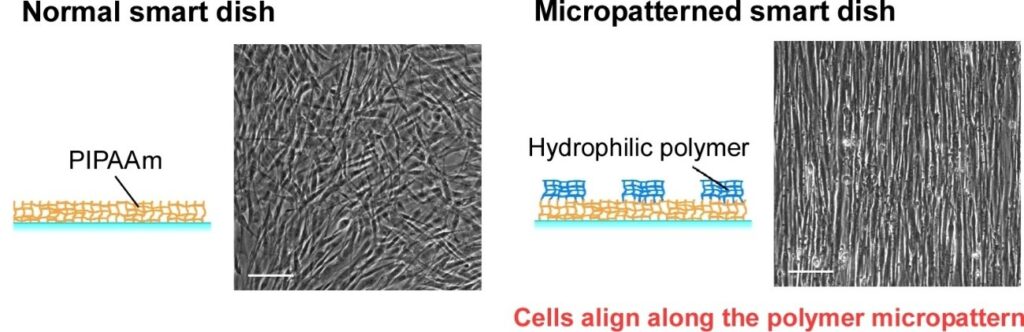
In vitro construction of complex microstructures such as alignment in muscular tissues is important for exhibiting their unique functions in living body, because the aligned muscle fibers exert mechanical functions such as muscle contraction. Cells can be aligned on 50 μm-line-and-space striped temperature-responsive surfaces grafted with two types of temperature-responsive polymers with different cell adhesiveness. Furthermore, by reducing temperature, the aligned cells are collected as a single cell sheet, which can be layered into three-dimensional tissues while maintaining the orientation. This approach is expected to be useful for the regeneration of skeletal muscle, myocardial, and ligament tissues where orientation structures are essential elements.